Motivation
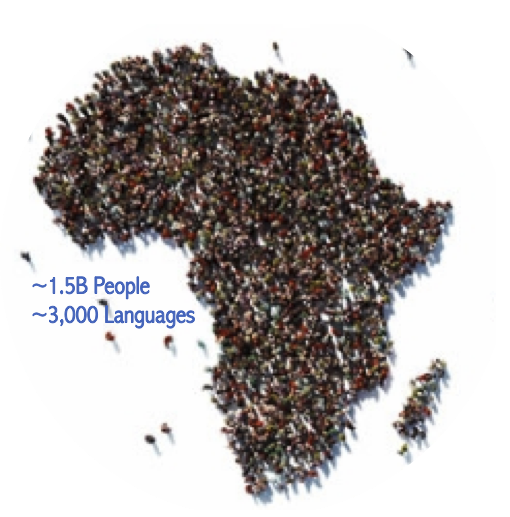
This symposium is an attempt to start discussions on speculative and work in progress towards African Natural Language Processing (ANLP). Africa, the ancestral home and origin of modern humans, is home to 1.4 billion people speaking over 2,000–3,000 languages. This linguistic hyper diversity creates an interethnic communication challenge that has been exploited by external forces to impose colonial languages as the default communication bridge between Africans who speak different languages. With the advent of AI-based NLP, many are questioning the use of these foreign languages, such as French, English, and Portuguese in the digital transformation of African economies and as a mechanism to enable Africans who speak different languages to communicate. On the other hand, given that African languages are classified as low-resource languages, current NLP approaches are not directly applicable.
The symposium will attempt to answer some fundamental questions related to the application of established NLP approaches to Low-resource languages, especially African languages. Can techniques for low-resource languages, such as language mixing and reverse engineering, lead to desired results? Are there some unique features of African languages that can be explored for ANLP? Do African languages have a common root that can facilitate ANLP? Can Hieroglyphics, a well-resourced and African symbolic language, be considered an African language? What role can it play in ANLP and could it serve as the basis of ANLP? These and many other challenges of low-resource languages will be discussed in the symposium. We invite you to participate in these discussions by: 1) submitting a position paper to address one or all the questions above; 2) registering as a panelist; 3) registering to attend the symposium to take part in the discussions; and 4) submitting a peer-reviewed paper in the main conference. These and other discussions in the symposium, we hope, will shape the future direction of African native language processing in the age of Large Language Models